Airborne transmission occurs through the dissemination of either:
- airborne droplet nuclei (small-particles 5 micrograms or smaller)
- dust particles that contain an infectious agent
Microorganisms carried by the airborne route can be widely dispersed by air currents and may become inhaled by a susceptible host.
All can be carried through the air and remain suspended for some considerable time before landing on previously clean surfaces or being inhaled by another patient or healthcare worker.
Research using air sampling has shown that many infective organisms, including C. diff, P. aeruginosa and MRSA can be transmitted by the airborne route. Air sampling before and after bed making showed that MRSA levels remain higher for up to 15 minutes after completion of the task. Healthcare facilities, including hospitals, use specialised ventilation and air-conditioning systems to help assure air quality around patients. A patient with a contagious disease, like tuberculosis or SARS, should be in a negative pressure environment to stop airborne infection travelling from their room. An air purifier will play a role in infection control, particularly in settings such as bone marrow transplantation units.
Bacteria and fungal spores can be considered as particles of size 25 microns to 0.25 microns, and 200 microns to 2 microns, respectively and, as such can be removed from the air with a high-efficiency particulate air (HEPA) filter. Viruses are much smaller, in the nanoparticle size range (0.025 to 0.05 microns) but can still be removed by the IQAir Cleanroom H13 which contains HyperHEPA technology, capable of removing particles down to 0.003 microns with a filtration efficiency of 99.95%.
The traditional solution to avoid transmission – the negative or positive pressure rooms – can often be expensive and difficult to implement, especially if they are retrofitted.
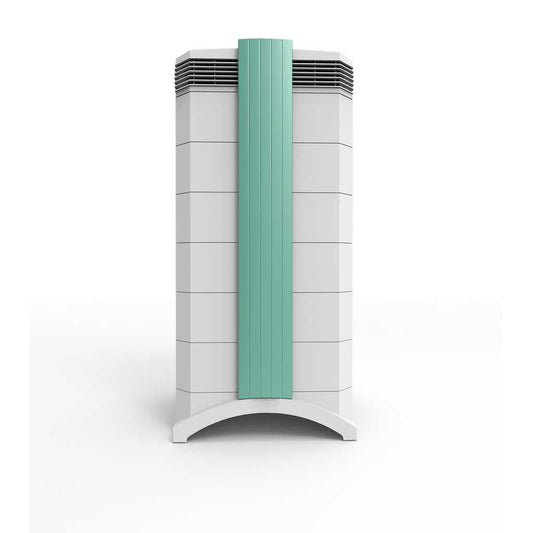
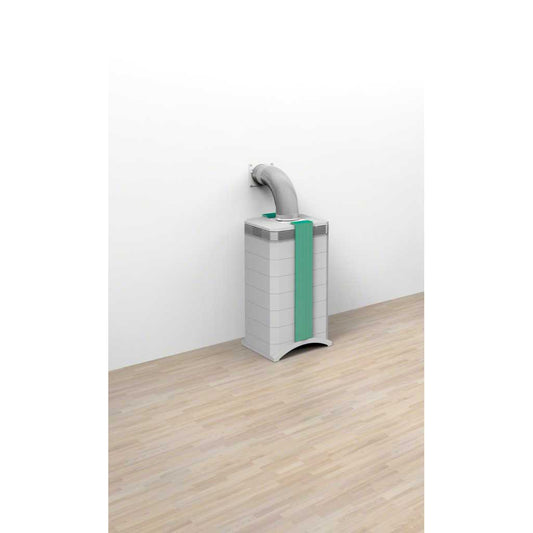
IQAir high-performance mobile air filtration units are compact, mobile, and highly effective. The leakage free H13 HEPA filtration is perfect for controlling airborne contamination and helping in preventing MRSA infection.